Sunday, February 17, 2019

People with Affinity to Jewish People Report, Israel 2017

The Ministry of Diaspora Affairs in Israel in 2017 released a comprehensive report titled “Report of the Public Advisory Committee for Examing Israel’s Approach Regarding Worldwide Communities with Affinity to the Jewish People”.

The report is interesting first because it uses new language to describe people of Jewish descent who may not be regarded as legal Jews - communities or People with Affinity. It recognised that Israel needs to formulates some proactive policy responses to people who are the legacies of the Inquisition and forced conversions more generally.

There has been a tide towards people wanting to explore their Jewish backgrounds and identities. The report’s authors describe this desire as an “ unprecedented surge... in individuals and groups seeking to establish affinity with the Jewish people”.There could be at least 5 million people globally of Jewish descent! it’s worth having a read of this report, in very user friendly language : http://www.mda.gov.il/antisemitism/documents/eng200818.pdf

Update on Leopold Emmanuel Jacob Van Dort

I have now accumulated lots of information from a variety of source in Hebrew and Dutch and will now be making a separate chapter on this amazing man. I am holding the information back for publication, however I will mention that contrary to certain views he had both a wife and a daughter. People need to be careful about asserting that just because family research shows individuals to be baptised in the Dutch Reform Church that they were 100% Christian. People were baptised for all sorts of reasons aside from faith issues. Baptism into Christianity gave people access to legal marriage, property rights and in some cases citizenship, so there were incentives.Research has shown that many people lived with so called double identities and really struggled, many also used multiple names.

Friday, January 25, 2019

I am not a genealogy search agency, Jewish Identity research is important no matter how incomplete!

I regularly get emails asking me whether their family is of Jewish origin or could I look up a relative. I am unable to assist you with this search. I am not a resident in Sri Lanka and also do not have links to current day activities. If you want information Chabad Sri Lanka should be able to assist you with kosher food issues etc. However, if you find any interesting information that you are prepared to share - maybe ending up in a book - I will check permissions with you - please email me!

This project has been a long one and I have had to stop work during changes to employment, country and general life sagas. I have gone back and added more details to the chapters, to be more precise, especially in sections where some of the argument is more conjecture.  There are people in many quarters who don't like this kind of research - some burghers don't want to admit that there are Jewish/Jewish identified burghers. Whilst some Jewish scholars because of the whole ongoing issues of 'who' is Jewish according to orthodox Jewish law, believe that there are not enough proofs.

It is clear from doing this research for over a debate that certainly during the colonials periods (Portuguese, Dutch, English) there was not a formally organised community in the way we would understand communal activities today. There is a strong likelihood that there was some kind of meeting house.Jews did network and hold gatherings. What becomes clear that for many Jewish folk in the 1600s  and 1700s who were forced the convert, or 'chose' to (ie. conversion was required for admission to university study in 1700s Holland) - that they carried a deep ambivalence about their status- some individuals going to great lengths to hide their previous heritage; others meeting up with other exiled folk to engage in underground political and religious activism. They carried with them a Jewish identity - even if it was fractured - not being fully accepted by Christians and being viewed suspiciously by Jewish communities. Policies designed to convert or kill Jews were aimed at breaking up the transmission of religious belief, religious practices; resulting in intermarriage and lost memories. This was a conscious policy by the Spanish and Portuguese of wanting to rid the world of Jews. Whilst this has not succeeded, nonetheless whole communities and lineages have been lost. So in my project I would rather speak of Jewish IDENTITY rather than Jews as such. A Jewish identity might involve a recognition of one's heritage or even more, a positive identification with Jewish ethics, and practices. These people would likely to have to go through a formal conversion process as there are too many broken links and not enough paperwork. It is time for certain sections of the Jewish community to engage in dialogue with individuals whose backgrounds have been affected by the operation of anti-antisemitism during the times of the European empires. The first step is writing up a 'history', . It maybe patchy, with some primary documentation sparse - but we do have access to secondary literature and accounts (even if distorted). Storying this is better than doing nothing - we maybe able to salvage some remnants!

N.B. IF YOU MAKE COMMENTS IN THIS BLOG, THEY ARE NOW IN THE PUBLIC DOMAIN AND CAN BE CITED BY ANYONE.

Wednesday, August 01, 2018

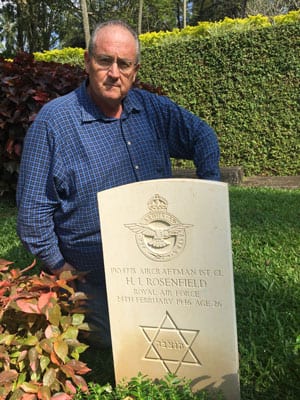
Jewish war grave in Kandy Cemetery

http://www.jwire.com.au/jewish-war-grave-sir-lanka/

In Kandy, Sri Lanka’s second largest city, there is the burial site of the Private Hyman Isaacs Rosenfield who was an aircraftman first class in the Royal Air Force. Mr Rosenfield is believed to be the only Jewish servicemen buried at the Kandy cemetery.
Out of the 1,999 Commonwealth war dead in Sri Lanka, it is believed there believed to be at least three Jewish soldiers buried on the island nation including a Sergeant who served in the Royal Australian Air Force and died in April 1942. He is buried in remote eastern Sri Lanka.
The Kandy cemetery is one of the six Commonwealth war cemeteries in Sri Lanka. The cemetery has been described as one of the most beautifully landscaped Commonwealth war graves.
Mr Secord said: “It was a bittersweet visit. Very little is known about Private Rosenfield and there are several spellings of his surname in official records.”
“However, he died on February 24, 1946 – about seven months before the Japanese surrender and well after fighting had ceased in Sri Lanka. Furthermore, he was quite young – only 26; had been a volunteer and had the lowest rank in the Royal air force.”
“However, his grave is historic to Jewish ex-service activists because about eight years ago, the Manchester chapter of the United Kingdom’s Association of Jewish Servicemen and Women (AJEX) issued a world-wide call for relatives for Mr Rosenfield to come forward.”
“AJEX had discovered that his gravestone had been mistakenly identified with a cross and they needed a family member’s agreement to replace it with a Magen David.”
“It now carries the Star of David and is the only known Jewish grave in the Kandy Commonwealth war graves’ cemetery.”

New Wikipedia entry

A new entry has appeared with some usual focus, when I get a chance I will update it. There’s information on a Tamil lineage in this entry which needs to be verified.
https://en.m.wikipedia.org/wiki/History_of_the_Jews_in_Sri_Lanka

Thursday, May 28, 2015

Prashan Rodrigo?? "The Jew who came from Nowhere" or "Diminishing Sri Lankan Royal Jews",

In 2009 I posted an item on Prashan Rodrigo who had self published a book on Jews in Sri Lanka. The books title is "The Jew who came from Nowhere" or  "Diminishing Sri Lankan Royal Jews",

I have had no responses for more information about the book or how to contact Mr Rodrigo. I do not have a copy of the book. So I am making a new appeal - if you have any further information, no matter how small - please contact me.

Book update

Plugging away slowly. Sometimes two sentences might take weeks of research and verification! I estimate that the book will run to around 77,000 words. I have spent a lot of time making sure all findings are verified for the purposes of evidence but also for use by future researchers. I have just finished the chapter on the Portuguese period which is about 5,000 words and am happy with the result.

Looking back at my essay which is online - I can see it's flaws and gaps. I know that the book will overcome these problems. The challenge also is the write for multiple audiences - the general learned public, family historians, academics, people with a knowledge of Sri Lanka (those with none), people familiar with Judaism (people totally unfamiliar) ... so hopefully there is enough for everyone.

Did you know?

Did you know that the notorious Jan Pieterszoon Coen Director General of trade policy in Asia for the VOC (Dutch East India Company) was a crypto Jew?

Monday, May 20, 2013

New Book on the Way?

Well eventually!!!! I am currently upgrading and correcting the unpublished article I wrote in 2007 (this is circulating on the web) into a book. New information and argument is being added, so if you have any new information, this is the time to email me (jewsinsrilanka@gmail.com). I am planning to have each of the time periods of colonisation constitute a separate chapter.

 I have been currently plowing though many source materials on Jews in the ancient Ceylon (Yes, many book sources will probably result in only a couple of paragraphs!). In June I will be in London and hope to access the Rothschild Archive to get more information on the (De) Worm brothers who first planted tea in Sri Lanka.

THE WHEELS TURN SLOWLY ... I am still working on the book (2015)

Sunday, October 02, 2011

The usual anti semitic stuff

I am afraid I have had no news items to report in the months since July. Thanks for the comments on the posts. The good news is that I have not had to delete any obscene comments like I have had to in the past. This favourable atmosphere cannot be extended to numerous Sri Lankan media reports that I have filtered on 'Jews in Sri Lanka' which are laced with anti semitism, rehashing Jewish world conspiracy theories, anti Israeli diatribes and holocaust denials.Email me if you have any news items.

Thursday, July 14, 2011

Vale: J. B. Muller (3.2.1943 – 19.6.2011)


Mr. J.B. Muller, journalist to now defunct Independent and Times of Ceylon newspapers  expired of a heart attack while going to Hospital on 19 June 2011. He was interred at the General Cemetery, Borella, on Tuesday, 21st of June, 2011.
J.B. Muller was the author of the book “The Burghers”, (ISBN 955-1535-00-6) and the book became Sri Lanka’s first audio book launched on 4th January 2007 at the Sri Lanka National Library in Colombo.

I had the pleasure of meeting J.B. in 2007 and whilst I have certain issues with the way J.B. built a case around burgher Jewishness and the lineage of Sri Lankan Jews, J.B. was a man known to be passionate and take risks. He was the first to put  Jews and Burghers together in the Sri Lankan media. This was in an environment where there is still a degree of tension around the nature and parameters of racial hybridity amongst certain sections of the burgher community. Muller was keen to support my own research and offered to assist people in the burgher community process their own ‘newly discovered’ Jewish ancestry.

As I said to Andrew Harris in his recent article in the Asian Jewish Life, Issue 6, 2011 “He [J.B.] is to be commended, … Although he tends to work not with hard evidence, but with inferences, Fiona freely admits that hard evidence is difficult to come by. (Harris, 201).

Daily News, Monday, 20 June 2011

MÜLLER - JOHN BARRY of 25, Poonagala Road, Bandarawela - 90100, (born in Colombo on the 3rd of February 1943). Beloved husband of Indrani, loving father of Claire, Carolyn, Esme, David and Lance, son of late Lionel Terence Müller and of Ethel Annlyn Rôdè (nee Van Langenberg), brother of Therese and Maurice. His mortal remains lie at A.F. Raymond’s Funeral Parlour. Cortege leaves at 5.00 p.m. on Tuesday 21st June. Burial at General Cemetery Kanatte (General Christian Section). No. 364/1, Polgahakottunuwa, Batakettara, Piliyandala. 

Link to a series of letters to the Burgher Association about the complex racial/ religious connections, including Jewish;


EḤAD MI YODE’A


EḤAD MI YODE'A (Heb. אֶחָד מִי יוֹדֵעַ; "Who Knows One?"), song incorporated in the Ashkenazi rite among the concluding songs of the Passover Haggadah, whose aim was "to keep the children awake" until the end of the seder (cf. Pes. 108b–109a). The song consists of 13 stanzas, made up of questions (Who knows One?.. Two?.. Three?.. etc.) and their corresponding answers. The reply to each succeeding question also repeats the previous answers. The last verse reads: Who knows thirteen? I know thirteen. Thirteen are the attributes of God; twelve the tribes of Israel; eleven the stars (in Joseph's dream); ten the Commandments; nine the months of pregnancy; eight the days of circumcision; seven the days of the week; six the books of the Mishnah; five the books of the Torah; four the matriarchs (Sarah, Rebekah, Leah, and Rachel); three the patriarchs (Abraham, Isaac, and Jacob); two the tables of the Covenant; One is our God in heaven and on earth. (SomeHaggadot have substituted other answers for the eighth and ninth questions of the traditional form. They read: nine are the Jewish holidays of the year, eight the Ḥanukkah lights.) In some places the song is chanted responsively: one person, usually the leader of the seder, asks the questions, and the whole company answers, each person responding as quickly as possible in an effort to finish the answer first. Eḥad Mi Yode'a is first found in Haggadot of the 16th century and only in those of the Ashkenazi ritual. Many scholars believed that it originated in Germany in the 15th century. Perles showed its similarity to a popular German pastoral song, "Guter Freund Ich Frage Dich" (one of the "Hobelbanklied" German folk songs), the first stanza of which ends with the same words as the Passover song. In fact, the identical words of this line of the pastorale are given as the German translation of the first answer of Eḥad Mi Yode'a in many early Haggadot. The Christian theme of the original was changed to one of Jewish content. Zunz discovered that the Hebrew song was used in Avignon as a festive table song chanted on other holidays as well, and Geiger noted other German counterparts. Since then it has been found among the liturgical music of Jews from Ceylon and Cochin, where it forms part of their Sabbath songs for the entertainment of bride and groom. Some scholars have even traced it to Greek or English church songs and Scottish nursery songs.
(emphasis added)

BIBLIOGRAPHY:

D. Goldschmidt, Haggadah shel Pesaḥ, Mekoroteha ve-Toledoteha (1960), 98; C. Zibrt, Ohlas obradnich pisni …(1928).

Web source:

http://www.jewishvirtuallibrary.org/jsource/judaica/ejud_0002_0006_0_05592.html

Tag International Development Project with Sarvodaya : “Children’s Stories about Peace.”

Tag is promoting two projects for youth at Sarvodaya @ Wattala. There’s the “Children’s Stories about Peace” project, described above, which aims to produce a series of stories for video and print, written, narrated and illustrated by children and teenagers from conflict zones and also Trash-Inc., which through the creation of an animated world for Internet and TV and a focus on environmental peace-building, offers an innovative, multi-strategy approach to the promotion of conflict mitigation and the building of mutual trust and empathy among children and youth. Tag is also involved in several additional projects in Sri Lanka, in partnership with Sarvodaya and supported by the American Jewish Joint Distribution Committee (JDC).

See full article from the Jerusalem Post
http://www.jpost.com/JerusalemReport/JewishWorld/Article.aspx?id=217775

Grave photos added to 2007 post

Go to the Archive for 2007:

TUESDAY, MARCH 06, 2007

Wednesday, July 13, 2011

Who is this man - Prashan Rodrigo?

The Island Newspaper, 13/01/2010, p 4.
Who is this man - Prashan Rodrigo?
This blog has no association with the site Sri LankanJewish run by Deshamanya Bastian Koralalage Jude Quintus Prashan Rodrigo.

There are Youtube clips of this man's book launch. He says some unusual things about Jews , some which gets lost in the quality of English syntax used. Any information would be great - the blog is plural, but I am careful that we have 'legitimate' information here?


The Island Newspaper, 17/12/2009, p. 2.

Conservative/Masorti Tradition teshuvot on ‘Jewish identity’

The Rabbinical Assembly of the Conservative/Masorti Tradition has published a teshuvot on ‘Jewish identity’ that maybe useful to blog readers of Sri Lankan Jewish origin who wish to claim / consider recognition. Remember this does not apply to orthodox tradition, which would appear to only offer ‘conversion’ as an option (if you do not have documents). In either case, you should consult with a Rabbi (more than one possibility) for guidance:
A mystery Cigarette Card sent to me by Rabbi Mendi Crombie. Here's the fruit of my enquiry thus far. Of course answers provoke even more questions:


This card was produced in 1889 by the Duke Cigarette Company and is called a "cigarette cards". The actress on the card is Belle Urquhart (1881 - 1882) and the card is from a series called Actor & Actresses Series #1.

This actress is obviously modelling what they believe to be the clothing of Jewish women in Ceylon in the 1880's. What unclear - is why choose clothing from Ceylon and (Jewish at that?). Is this representation of fashion based on reality - stories of travellers or, is it a fantasy that is a part some theatrical drama? It seems strange that the company picked an Island where Jews supposedly were so few in number to even be noticed?

Lost in Kandy ... A Passing Encounter

I received this email from a blog reader "JP", and he has agreed to have me share it with you. Obviously the encounter took place in the early 1980's. The Jewish man concerned may not be alive - any update to this story please add them to the comments below.
~~~~~~~~~~~~~~~~~~~~~~~~~~~~~~~~~~~~~~~~~~~~~~~~~~~~~~~~~~~~~~~~~~~~~~~~

I came across your blog and thought to share my anecdotal experience with respect to jews in sri lanka as to this day it remains a unique event in my life.

Upon graduating university in 1982 I set out on backpacking journey that took me through the south pacific, australia, and ultimately into Indonesia and asia.  After about a year and a half into my journey I found myself in Sri Lanka.Though I landed in Colombo, the only thing I can remember about the city is the dusty bus station that took me immediately out into the countryside.  I moved from beach to beach around the perimeter of the island until I finally decided to head inland toward Kandy. 

Whatever vestiges of western clothing and look i had at the time I left los angeles had long been discarded by the time I reached Kandy.   My hair was to my back, my skin dark, and my clothing was local shorts and sandals.  I share this only to say that there was nothing about my appearance that would give much about me away.  In fact, all throughout this part of world, “travelers” like myself were relatively common and we looked like each other more than anyone else from anyplace else.

During afternoons in Kandy there would be a procession of people making offerings of flowers and incense in the local temple.  People would line up, there coal black faces contrasted against their traditional white wraps.  I enjoyed this and like other travelers would join in this and other local customs.One afternoon, no different than any other, I was in line waiting my turn to bring  flowers into the temple when a very old man approached me.  Like every other Sri Lankan, he was dressed in white, his skin as dark as coal, yet there was still something different about his look. 

Sri Lankans had for the most part very consistent facial features, large brown eyes, oval yet defined facial structure, average noses.  This man’s face was far more angular, with a nose my uncle larry would be proud of.  He looked for all intents and purpose like an extraordinarily tan version of one of the old guys from my father’s golf club.

You see, I’m jewish, and I know an old Jew when I see one, heck I grew up around them.  To be clear, my nose is small, I am tall and athletic, and there was nothing about my outward appearance that would suggest religion at all.  What was amazing is that this very old Sri Lankan came up to me and the first words he said to me, in thick sri lankan accent was, “I know your jewish, right?” 

“Right”, I responded, though completely dumbfounded.  “How did you know?” I asked.

“I just know.  I am too.  Can you help me?”  He asked.

“How?” I asked.

He asked if when I went back home if I could arrange for Torah the Talmud to be sent to him and his people.  That they did not have them and that they’re Jewish tradition was passed along orally.  He told me that he and his family had lived there for hundreds of years. Tears formed in his eyes as he shared stories with me and about the excitement of getting the books he had long hoped form  He gave me the address where  to send it and left.

When I returned to the U.S. I had spent so much time in and out of South East Asia, going back and forth between countries that the customs officials viewed my with caution and went through every micro possession I had including giving me a strip search.  By the time I collected everything, left the airport, and finally unpacked I realized to my sadness that the slip of paper with the address on it had gotten lost.

I went to my families’ temple to inquire about jewish community in sri lanka and sending what I had promised.  I was told that there is no indigenous jewish community to contact and that the only jews to speak of are the ex-pats from Israel, America, Australia, etc.  I explained that there is a historical community there, but no one here had any knowledge of it.

It was my hope to fly back and fulfill my promise, however, very shortly after my return to the states the conflict with the tamils really erupted which lasted until now.  I found your blog because the event still resonates with me and  I would still love to fulfill my promise if it’s needed, but even now in 2010 there little if anything that can be found written or mentioned about a group of people I know are there.   Hopefully this story finds you and you find it interesting.

Secrets of Ceylon: What happened to the Jews of Sri Lanka, from Asian Jewish Life, Issue 6, 2011

Andrew Harris' latest piece. I think Andrew has diplomatically covered many of the complex issues.
Here's the link:
http://asianjewishlife.org/pages/articles/AJL_Issue_6/AJL_Feature_Ceylon_Sri_Lanka.html

Wikipedia post on Sidney Abrahams has an error: Correction here


Sidney Abrahams, Chief Justice  was married in 1914 to Ruth Bowman and had two children, Valerie, and my husband Anthony.  There was indeed another Sidney Abrahams married to Rebecca Berkon, but this was not the Chief Justice of Sri Lanka.
Information supplied by Elizabeth Abrahams